EMMA Data Deposition Guidelines

The Laboratory Animal Genetic Reporting ( LAG-R) guidelines aim to standardize the reporting of genetic details in laboratory animal research to improve reproducibility, reliability, and transparency. These guidelines align with the FAIR principles (Findability, Accessibility, Interoperability, and Reusability) by promoting the comprehensive documentation and sharing of genetic and phenotypic information. Adhering to both LAG-R and FAIR principles is essential for enabling researchers to accurately replicate studies, compare findings, and advance scientific knowledge more effectively.

By depositing data in public repositories like the European Mouse Mutant Archive (EMMA), researchers not only preserve crucial information but also make it accessible to the global scientific community, fostering collaborative and innovative research across disciplines.

At INFRAFRONTIER we are committed to the LAG-R guidelines and the FAIR principles and we strive to meet them.

The EMMA online submission form

The EMMA online submission form can be found here.

The initial page of the submission form contains relevant information, including:

  • the submitter must be the sole owner of the allele/strain or have permission from all owners to deposit the strain into the EMMA repository;
  • the evaluation process takes up to 60 days;
  • multiple strains (also if the same allele is submitted on different genetic backgrounds or if multiple founders are to be deposited) must be submitted separately – one strain per submission.

The user must actively accept the  EMMA repository conditions and the  Data Privacy Statement in order to start the submission.

Once the submission is started, the submitter will receive an email with a secure access link that can be used at any time to continue and finish the submission of strains to INFRAFRONTIER. Please keep this link confidential, as anyone with the link can access your submission.

The submission form consists of 9 different steps including ‘Preview and Submit’. The user can navigate to any step in advance by clicking the tab/step heading. On each step, the submitter has the option to ‘Save and continue’ to next step or ‘Save and exit’ the submission process. Either one or the other option must be clicked to save the entered data.

Please find below detailed information about the data that needs to be entered in each step. Mandatory fields are marked with *.

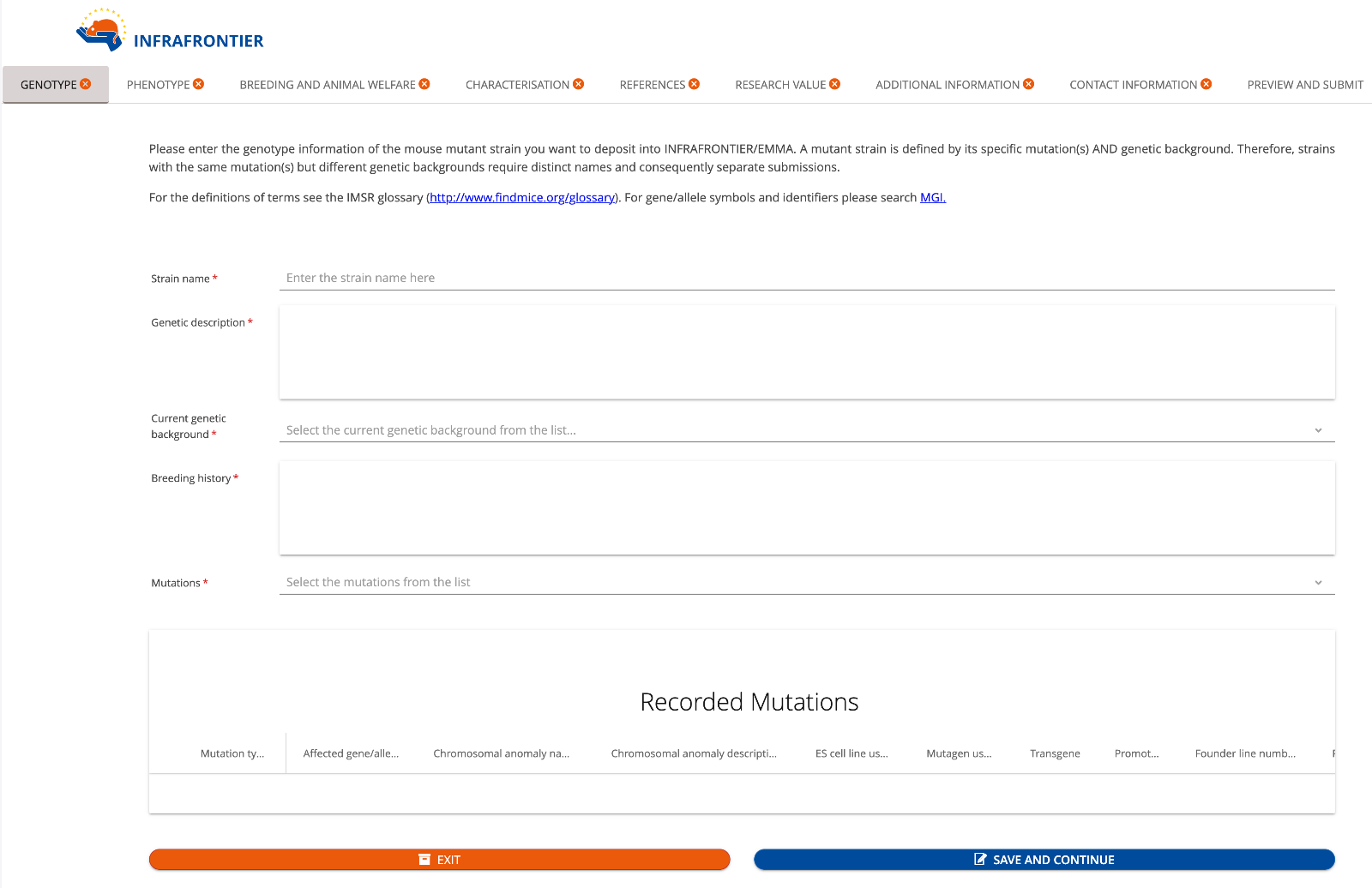
GENOTYPE

Please enter the genotype information of the mouse mutant strain you want to deposit into INFRAFRONTIER/EMMA. A mutant strain is defined by its specific mutation(s) AND genetic background. Therefore, strains with the same mutation(s) but different genetic backgrounds require distinct names and consequently separate submissions. For the definitions of terms see the IMSR glossary (https://www.findmice.org/glossary). For gene/allele symbols and identifiers please search MGI.

Strain name*
Please enter the mutant mouse strain name, either following https://www.informatics.jax.org/mgihome/nomen/index.shtml – official nomenclature rules – or using the name you used when publishing the strain. You can add any internal lab slang names in parentheses, as this can make it easier to identify cage/box labels when mice arrive at an EMMA node. These alternative names will also be saved and made searchable on our public strain list later. If you are submitting lines on more than one background, please include the background in the strain name and submit each line separately.

Genetic description*
Describe which gene(s) has/have been mutated and what approach was used, including any genome engineering enzymes (e.g. nucleases or recombinases), guide RNA sequences, and other relevant reagents, where applicable.
Please provide the origin of all mutant alleles, including those not originally generated by the submitter, specifying the originating laboratory, repository, supplier, or other source.
Please also confirm if the submitted line is one of the following:
a. Post-flp: carrying a conditional, “floxed” allele with removed antibiotic-selection cassette, etc.
b. Post-cre: carrying a constitutive or tissue-specific “knock-out” or “knock-in” allele, etc.
This text will be displayed on the public strain list.

Current genetic background*
Start typing and/or select from the drop down menu the background of the mouse strain that is being submitted.

Breeding history*
Please report in this field all details of all stages of the strain’s development and breeding history, also including:

  1. The complete background of the strain on which the original mutation was produced/ original transgene construct was inserted. This includes, but is not limited to, the following, if applicable:
    a. For Targeted Mutations (TM) or Endonuclease Mediated (EM) mutations: the complete background of targeted ES cell line/ injected blastocysts/ CRISPR/Cas-injected zygotes.
    b. For Chemically Induced mutations (IN): the complete background of the treated animals and the mutagen used (e.g. ENU).
    c. For Transgenic mice (TG): the complete background of transgene-injected zygotes.
    d. For Spontaneous mutations (SP): the complete background of the strain on which the original spontaneous mutation arose.
  2. The complete background of all the wildtype strains which the original mutant line was crossed with. Please include whether backcrossed or outcrossed and the number of crosses (generations).
  3. The number of intercrossing generations (brother x sister mating), if applicable.
  4. If the strain has been crossed with a Cre/Flp/Dre recombinase-deleter or a tissue/stage specific-driver strain, please include the published background along with relevant bibliography references for these strains.
    Note: If possible, please include the substrains (for example : C57BL/6J instead of C57 or C57BL/6).
    This information will be shown on the public strain list.

Mutations*
Select the mutations from the list:

  • Chromosomal anomaly (Affected gene/allele, Chromosomal anomaly name, Chromosomal anomaly description, Original genetic background)
  • Gene trap (Affected gene/allele, ES cell line used, Original genetic background)
  • Induced (Affected gene/allele, Mutagen used, Original genetic background)
  • Spontaneous (Affected gene/allele, Original genetic background)
  • Transgenic (Transgene, Promoter, Founder line number, Plasmid/construct name or symbol, Original genetic background)
  • Targeted (Affected gene/allele, ES cell line used, Original genetic background)
  • Endonuclease mediated (Affected gene/allele, Original genetic background)
  • Undefined (Affected gene/allele, Original genetic background). The mutation details entered above will automatically be saved once the ‘Save and continue’ button at the bottom of this page is clicked. If your strain carries multiple mutated alleles, you can ADD AN ADDITIONAL MUTATION OF THE SAME STRAIN

PHENOTYPE

Phenotypic description of mice homozygous for the mutation*

Phenotypic description of mice heterozygous or hemizygous for the mutation*

BREEDING AND ANIMAL WELFARE

Are homozygous mice viable?*
Yes/No/Only males/Only females/Not known

Are homozygous mice fertile?*
Yes/No/Only males/Only females/Not known

Are heterozygous/hemizygous mice fertile?*
Yes/No/Only males/Only females/Not known

Please note that due to its methodological simplicity and reduced costs, for most strains sperm will be cryopreserved. Embryo cryopreservation will only be considered in special cases where the strain background may not be available in the archiving centre in order to preserve the genetic background upon recovery and/or for strains containing several mutations.

Are homozygous matings required?*
Yes/No

Breeding and reproduction details

Husbandry requirements

Are mice immunocompromised?*
Yes/No/Not known

Details of any phenotype or welfare issue which may affect animal breeding and care
If there is a classification of severity (non-harmful, mild, moderate, severe phenotype) according to your national legislation, this can be given here.
Please also describe any notable phenotype and provide relevant references or phenotype assessments (e.g. SHIRPA), where available.

Health report – File upload (PDF)

CHARACTERISATION

Upload PCR protocol (PDF).

You can download our PCR protocol template and use it or provide your own document.

If a PCR protocol is not available, please describe characterisation by other method.
Please describe the steps taken to minimise and assess off-target effects in your mutant mouse strain. Include any tests performed or other evidence supporting specificity of the genetic modification.
If a PCR protocol is not available: describe how the strain can be characterised: Southern, phenotyping or other method.

What have you done to minimise / to control off-target effects?
Please describe the steps taken to minimise and assess off-target effects in your mutant mouse strain. Include any tests performed or other evidence supporting specificity of the genetic modification.

How was the genetic alteration validated?
If performed, describe how the modified allele was validated, including sequence verification, confirmation of the expected allele structure, and assessment for unintended integrations or rearrangements. Please include the methods used and the outcome of the analyses. 

REFERENCES

Has this mouse mutant strain been published or accepted for publication?*
Published/Accepted/No/Not known

If Published or Accepted is selected, the following appears:

Short description*
Please select an option:

  • Generation of the mutant mouse strain
  • Description of the mutant phenotype
  • Generation of the mutant mouse strain and description of the mutant phenotype
  • Other (please specify)

PubMed ID
Details will be autocompleted from PubMed service based on the ID entered.

If PubMed ID not available, provide details here

The publication details entered above will automatically be saved once the ‘Save and continue’ button at the bottom of this page is clicked. If you would like to record several references, you can ADD AN ADDITIONAL REFERENCE


RESEARCH VALUE

Does this strain model a human condition or disease?*
Yes/No/Not known

DO (Disease Ontology) terms. Start typing the relevant DO (Disease Ontology) terms… https://disease-ontology.org

Research areas
Start typing the relevant MSH (Medical Subject Heading) terms… https://www.nlm.nih.gov/mesh/meshhome.html

Research tools
Select the applicable research tools from the list

  • Cre recombinase expressing strain, i.e. the strain can be used to delete sequences flanked by loxP sites in breedings
  • FLP recombinase expressing strain, i.e. the strain can be used to delete sequences flanked by FRT sites in breedings
  • Strain with TET expression system
  • The strain contains sequences flanked by loxP sites
  • The strain contains sequences flanked by FRT sites

Additional information
You can enter additional information about the usefulness of the strain for modeling human diseases, studying certain research areas, or application as research tools. If the strains models a rare disease, please list the Orphanet identifier(s) here.

ADDITIONAL INFORMATION

If you would like your institutional Material Transfer Agreement (MTA) to be completed by scientists who want to receive your strain from EMMA, you can upload the blank document here. You can also always provide it later on by r-znvy.

Please note that from EMMA’s side it is not required to provide an MTA. In any case the intellectual property stays with the original producer and deposited strains are archived and distributed under the EMMA repository conditions.

MTA File – upload (PDF)

Are there any intellectual property rights or patented technologies linked to this strain?*
Yes/No/Not known

Is the producer the exclusive owner of this strain (including all original materials, e.g. alleles or constructs, used for its generation)?*
Yes/No/Not known

Do you have permission from all owners to deposit this strain in the EMMA repository?*
Yes/No/Not known

ILAR code of mouse producer
Please enter the producer’s ILAR-registered laboratory code to be used for developing the official strain designation consistent with the rules and guidelines established by the International Committee on Standardized Genetic Nomenclature for Mice. If the producer does not have an ILAR code, it can be registered on-line at The National Academy of Sciences using the link supplied. EMMA staff can assist with the registration procedure. ILAR Registration Link

Is this strain being deposited with any other institution or company intending to make it available for distribution?*
Yes/No/Not known

Are other laboratories producing similar strains?*
Yes/No/Not known

How many requests for this strain have you received in the last 6 months?

Do you require delayed release for this strain (max. two years grace period)?
Yes/No/Not known

If yes is selected:

Please explain here why a delayed release is required for this strain.

How many mice of breeding age could you provide and when?
Males, Females, Month and Year
Mice of breeding age must be provided. Minimum of 5 females and 5 males for freezing as homozygotes. Minimum of 5 males for freezing as heterozygotes. Provision of more mice than the specified minimum will considerably accelerate the freezing process

Upload additional materials of interest (Up to 5 attachments) (PDF)
Up to 5 attachments: e.g.:

  • SNP analysis (such as MiniMUGA)
  • severity assessment
  • sequence files of the genetic modification
  • allele schematics
CONTACT INFORMATION

In this section you need to provide the full affiliation and contact information for the submitter, the strain producer and the shipping contact.

After submitting the strain:

  • the fields will be deactivated for editing. Only the ‘Preview’ and ‘Export to PDF’ functionalities will remain available;
  • the user will receive an email acknowledging submission and informing about the next steps;
  • if the submission data is incomplete or unclear, the INFRAFRONTIER scientific user support will get in touch with the submitter to clarify unclear points, which can lead to delays in the evaluation process.

Submitted strain data will be published on the INFRAFRONTIER EMMA public strain list once the strain has been accepted for archiving at EMMA and archiving has started.

An example submission corresponding to this strain is provided for reference.

Further reading

Improving Laboratory Animal Genetic Reporting: LAG-R Guidelines

Better understanding of laboratory animal genetics will improve reproducibility

INFRAFRONTIER® and European Mouse Mutant Archive - EMMA® are registered trademarks at the European Union Intellectual Property Office (EUIPO).